
Operate
Managed Network Services
Run office, branch, campus, and remote-team networks with monitoring, change control, device backups, documentation, and monthly evidence.
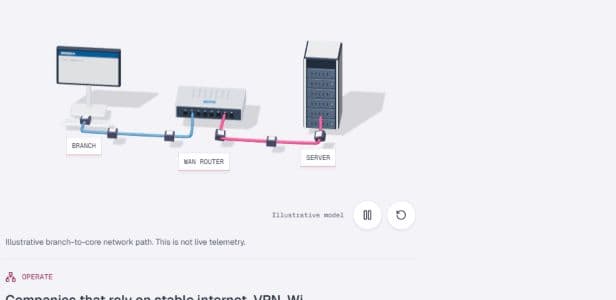
Illustrative branch-to-core network path. This is not live telemetry.
- 01Current stateMap the environment and pressure.
- 02Authorized scopeAgree access, impact, and owners.
- 03Engineering workOperate, change, or remediate.
- 04Verified handoffDocument evidence and next controls.
Best fit
Who this service is for
Companies that rely on stable internet, VPN, Wi-Fi, firewall, branch, and cloud connectivity but lack consistent network ownership.
The engagement turns network state into an operating record: inventory, topology, alerts, changes, backups, incidents, and recurring review.
Outcomes to plan for
- Improved uptime
- Faster RCA
- Documented network state
- Predictable support
Operational triggers
Choose this service when these signals appear.
Scope
What we inspect, operate, or change.
Agree the systems, access permissions and change boundaries before work starts. The engagement scope determines which activities are included.
- Device and circuit inventory
- Monitoring and alert review
- Configuration backup plan
- Change log discipline
- Monthly health reporting
Deliverables
What remains with your team after the work.
- Network state report
- Risk and improvement backlog
- Escalation matrix
- Backup evidence
- Monthly review summary
FAQ
Questions to resolve before work begins.
What is included in managed network services?
Managed network services can include monitoring, device inventory, firewall and VPN review, configuration backup, incident response, change documentation, reporting, and improvement planning.
Can QCS support a mixed-vendor network?
Yes. The model is designed for mixed environments across Cisco, Fortinet, Palo Alto, Sophos, Aruba, Ubiquiti, MikroTik, AWS, Azure, Google Cloud, and related platforms.
Request review
Discuss managed network services.
Tell us about your environment, the issue or project, and the outcome you need. Do not include passwords or sensitive configuration details.