
VPN modernization path
Confirm the condition with evidence that engineers and owners can review together.
Modern access solution
SASE and Zero Trust readiness connects identity, remote access, device posture, cloud connectivity, firewall policy, user experience, and monitoring.
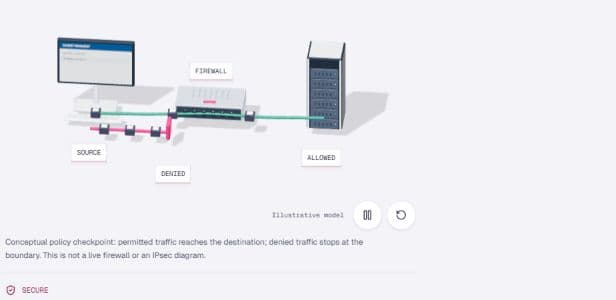
Conceptual policy checkpoint: permitted traffic reaches the destination; denied traffic stops at the boundary. This is not a live firewall or an IPsec diagram.
Direct answer
Problem pattern
Expected outcomes
Confirm the condition with evidence that engineers and owners can review together.
Give the next action a clear owner, priority, and validation criterion.
Reduce uncertainty before a production change, escalation, or service request.
Retain a decision record that supports remediation, retesting, and follow-up.
Recommended service path
Harden firewalls, VPNs, remote access, segmentation, logs, DNS, email pathways, and Zero Trust readiness.
View serviceDesign and secure AWS VPC, Azure VNet, Google Cloud VPC, site-to-site VPN, routing, private access, and public exposure.
View serviceRun office, branch, campus, and remote-team networks with monitoring, change control, device backups, documentation, and monthly evidence.
View serviceTools and assessments
Diagnostic path
Score uptime, monitoring, firewall age, remote access, incidents, and documentation quality.
Open toolDiagnostic path
Check VPC/VNet structure, hybrid connectivity, exposure, logs, segmentation, and cost-performance friction.
Open toolDiagnostic path
Assess rule sprawl, broad allow rules, logs, admin access, VPN users, and config backup health.
Open toolFAQ
No. Zero Trust is a security model. SASE is a cloud-delivered architecture that often combines SD-WAN, ZTNA, SWG, CASB, and FWaaS.
Start with users, applications, current VPNs, identity, device posture, internet access, cloud routing, and logs.