
Reduced exposure
Confirm the condition with evidence that engineers and owners can review together.
Network security solution
Firewall cleanup should be risk-ranked by exposure, ownership, hit count, service criticality, logging, VPN access, and rollback readiness.
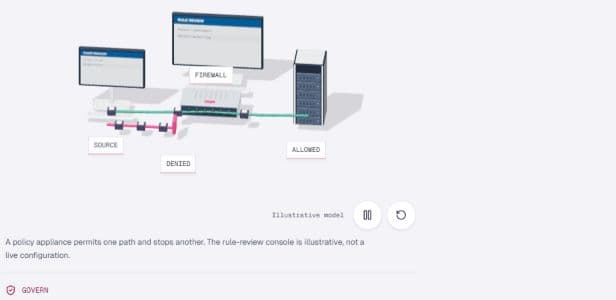
A policy appliance permits one path and stops another. The rule-review console is illustrative, not a live configuration.
Direct answer
Problem pattern
Expected outcomes
Confirm the condition with evidence that engineers and owners can review together.
Give the next action a clear owner, priority, and validation criterion.
Reduce uncertainty before a production change, escalation, or service request.
Retain a decision record that supports remediation, retesting, and follow-up.
Recommended service path
Review, clean, document, and manage firewall policies, VPN users, admin access, logging, and config backups.
View serviceHarden firewalls, VPNs, remote access, segmentation, logs, DNS, email pathways, and Zero Trust readiness.
View serviceScope and perform external, internal, web, API, cloud, and wireless penetration testing with remediation guidance and retesting.
View serviceTools and assessments
FAQ
It can be risky if done blindly. A controlled cleanup uses exports, hit counts, owner confirmation, staged changes, and rollback plans.
Review source, destination, service, NAT, VPN users, admin access, logs, backups, firmware, and change ownership.